WEEK 1 6 January
Meet your robot arm
Unpack the kit, identify the parts and follow a guided setup. Learn how a complete electrical circuit supplies the kit safely.

Year 10 · Live online · Starts 6 January 2027
A kit at your door.
Physics in your hands.
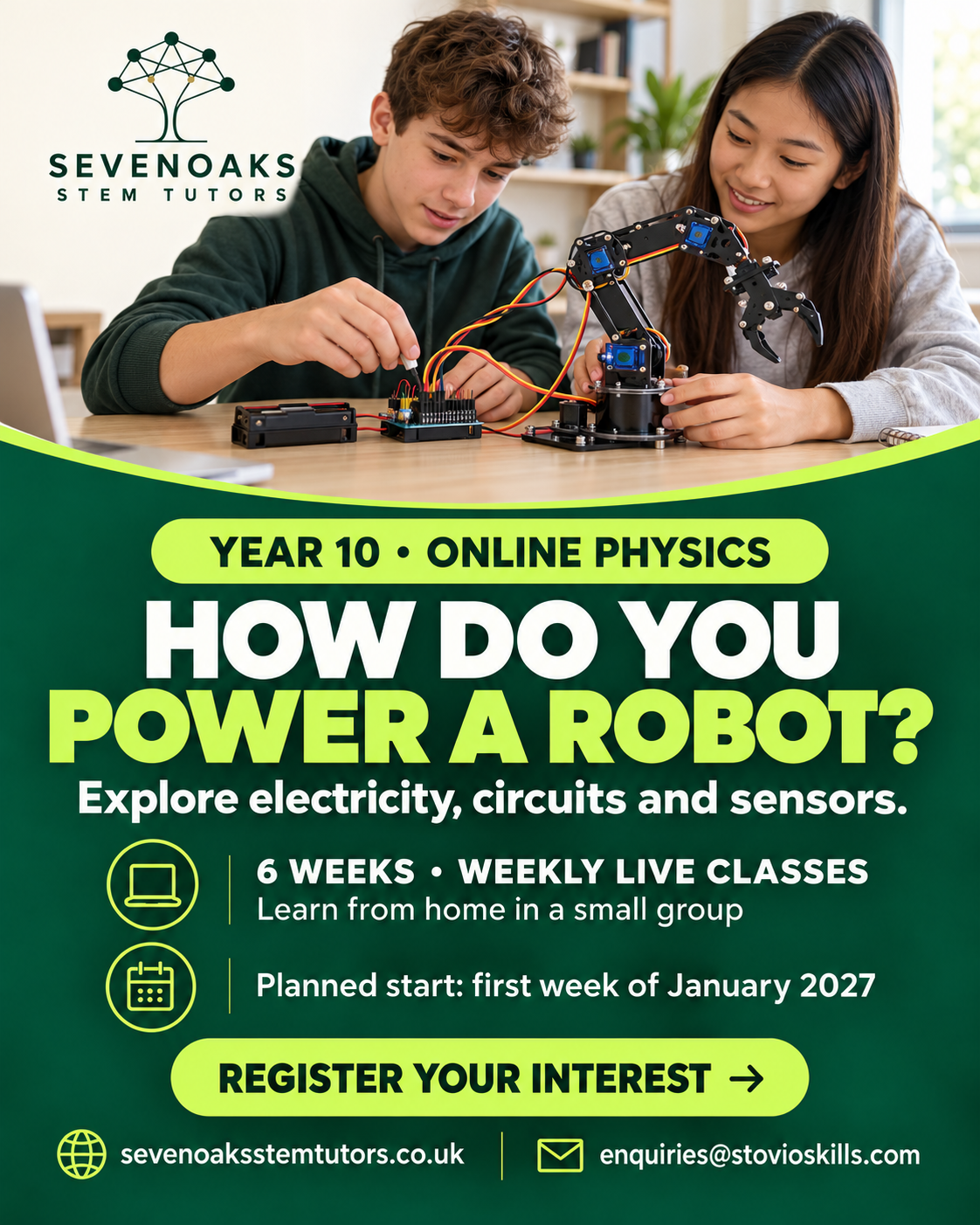
Explore electricity through a robot-arm actuator kit, with cables, controls and guided practical tasks. Learn from home in a small group, with Ben helping you make sense of what happens and why.
Register interest for January ↗No payment or commitment to book.
Not just watching. Working it out.
This is a six-week introduction to selected GCSE electricity ideas through practical engineering. You will work through a kit together, use calculations and explain your results. No previous coding experience is needed.
Designed for Year 10 learners, including home-educated students. The live sessions are planned for Wednesday daytime, UK time; the exact start time will be confirmed before booking. International families are welcome to enquire about time zones and kit delivery.
Your six-week journey
A simple working outline. Activities will be finalised around the tested kit and learners’ starting points.
WEEK 1 6 January
Unpack the kit, identify the parts and follow a guided setup. Learn how a complete electrical circuit supplies the kit safely.
WEEK 2 13 January
Explore current, voltage and resistance using simple circuits and measurements. Connect the quantities in GCSE equations to what you see.
WEEK 3 20 January
Use the kit’s controls to move an actuator and explore how electrical energy becomes movement. Compare series and parallel circuits in separate learning activities.
WEEK 4 27 January
Practise controlled movements and investigate how inputs change what a device does. Explore sensors through a demonstration or simulation.
WEEK 5 3 February
Investigate power, useful movement and energy transfers. Use simple calculations to estimate energy use and discuss why loads and friction matter.
WEEK 6 10 February
Work through a guided pick-and-place challenge. Demonstrate your arm, explain the physics and review the GCSE ideas you have practised.
Ready to learn at home
Your course kit will be posted to you before the first class. We guide you through setup and use it together during the course.
The kit is being selected and tested. We will confirm its contents, delivered price and dispatch arrangements before you book. Overseas shipping is checked individually.
We will confirm any device or software requirements before booking. Guided tasks use low-voltage equipment, not mains wiring.

Learn with Ben Walker
Ben is a qualified teacher and engineer who connects classroom ideas with practical applications. Small-group discussion, guided tasks and feedback help learners work through questions rather than simply follow instructions.
There are 12 scheduled hours across six classes, including short breaks, plus small between-session tasks and a closing learner/parent progress summary.
Selected topics connect to AQA GCSE Physics (8463) and Combined Science: Trilogy (8464): current, voltage, resistance, circuits, electrical power and energy. Robotics provides the application; this is not a complete GCSE electricity unit or a replacement for school required practicals.
Before you join
Tuition and the posted kit will be priced separately. The total cost, including applicable delivery charges, will be confirmed before booking. Registering interest is free and does not reserve a paid place.
The project centres on setting up and using a robot-arm actuator kit, not designing a complete autonomous robot from scratch. The aim is to understand and explain the electricity behind movement and control.
The course is designed around selected AQA GCSE electricity topics. Learners studying other boards can enquire; Ben will check the course’s fit with their goals and starting point.
These are live classes, not a recorded video course. Joining details and setup guidance are supplied before the start. A parent or carer makes the enquiry for under-18s. Read our safeguarding commitment.
January 2027
Tell us a little about the learner. Ben will confirm suitability, the Wednesday start time and the total price before you decide.
6 January–10 February 2027
Six weekly online classes.
Prefer email?
enquiries@stovioskills.com